Where the War Went
Part One of The Layers of a War
I don’t remember getting on the bus. I only remember the man who got on after us.
He was big in the way that men with guns are big, not just in body, but in the space they take from everyone else in the room. A ski mask where his face should have been. A rifle across his chest like something he’d been born holding. I tried to see him from behind the seat in front of me. Then I tried not to be seen.
I was three years old. I already knew how to do that- how to make myself smaller than I was. How to sink.
The gymnasium smelled like it had been closed for a long time, and then filled with too many people, and then closed again. Old wood. Sweat. And underneath it, something that shouldn’t have been there… urine, feces… a smell that didn’t make sense to me then but does now. The soldiers had plugged the toilets. That was the point. To remind us what we were to them.
My mother had packed my potty in her purse.
I think about that now… what she decided to bring, in the hours before we left. What a mother packs when she doesn’t know what is coming. She brought my potty. She was still thinking about me, still planning for the ordinary needs of a small child, even as everything around us had stopped being ordinary.
I was just learning to use it on my own. I was learning in there, in that smell, in that dark.
I remember the lights as we walked in. Strobes, flashing behind us, illuminating the path into the school. I didn’t understand what they were for. I think now they wanted to make it permanent… to sear it into us, into our bodies, so we would never forget that we had been brought here. So we would carry it. It worked. I am still carrying it.
At some point in those three days, she pulled my brother close and said something I wasn’t supposed to hear.
Take care of your sister. If something happens to me.
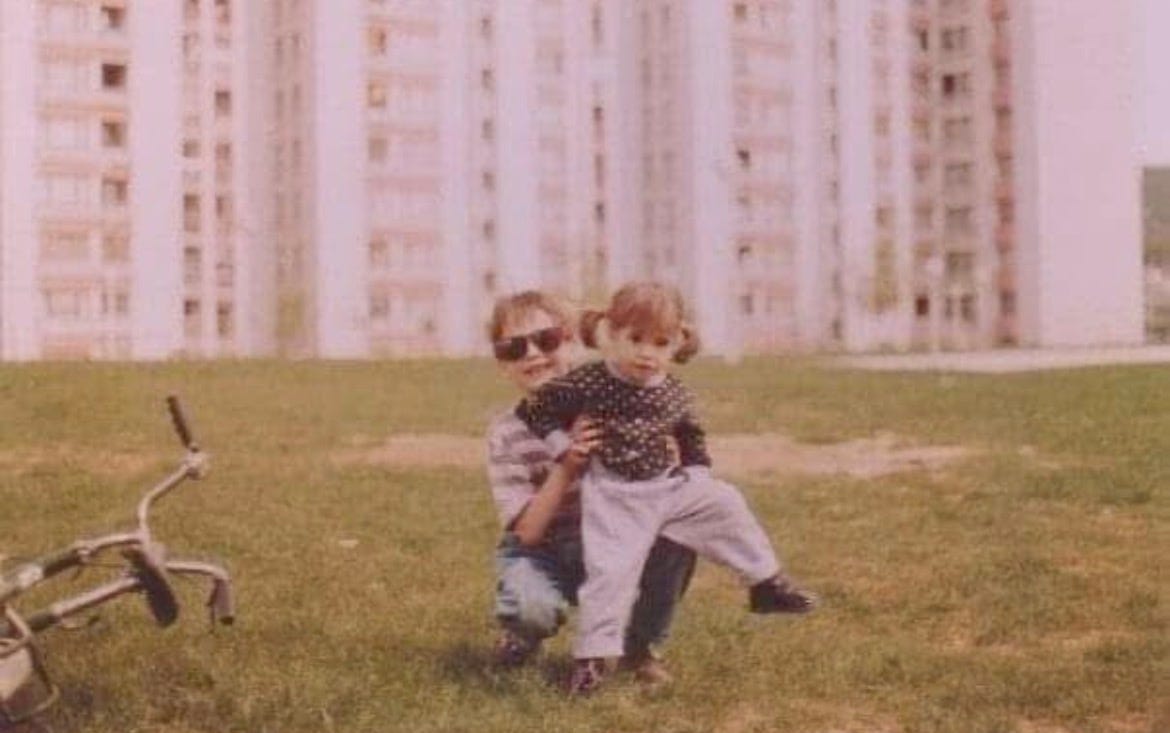
I didn’t know what to do with those words. I don’t think I did anything. I think I went still. The way I had learned to go still on the bus, behind the seat, trying to take up less space than I needed.
I have spent most of my life trying to take up less space than I need.
The gymnasium was packed. Loud in the way that too many frightened people in one room is loud and quiet in the same way, because everyone was trying not to be the one who made things worse. Children who had stopped crying. Mothers who had stopped asking questions. A collective holding of breath.
At some point my mother found a phone. I don’t know how. I only remember her voice…. careful, measured, the way you speak when masked men with weapons are listening to every word. She was talking to my father. Somewhere outside all of this, he existed. He was still alive. She was making sure he knew we were too.
I watched her face while she spoke. I was always watching faces by then. Learning to read what wasn’t being said.
During those three days, they would load us back onto the buses. I don’t know how many times. All I remember is the feeling… the sudden movement, the belief that this was it, that we were finally leaving. And then the slow understanding, as the bus circled and returned, that we were not going anywhere. That the leaving was not real. That hope, here, was something they could hand you and take back.
My brother was nine years old. He could only survive that loop so many times.
He had been told, hours earlier, to take care of me if something happened to our mother. Nine years old, and that sentence had been placed inside him like a stone. I didn’t understand it then. I understand it better now. What it does to a child to be handed that kind of weight. To be asked to be something no child should have to be.
He broke in that gymnasium. I saw it happen. The hope went out of him – the belief that we would see our father again, that this would end, that we would go home. I watched my nine year old brother lose that.
I don’t know what I did. I think I went still. I was already good at that. Ar making myself small and quiet and present without taking up space. At witnessing without being witnessed.
Three days we were in there. Three days in that smell, in that loud quiet, with the men watching and the toilets plugged and my potty in my mother’s purse and my brother’s broken face and my mother’s careful voice on the phone.
And then the United Nations came, and they let us go.
Just like that. As if three days in that gymnasium was a thing that could simply end.
It doesn’t end. It just finds somewhere to live.
If this piece spoke to something in you, you can subscribe to Healing the Layers on Substack for new essays, reflections, and notes on healing in layers — through the body, heart, mind, and meaning.
If you’re new here, I also made a free guide called Where Am I? to help you gently locate what feels loudest right now and find one honest next step.
Healing isn’t linear. It’s layered.